
Newsletter 5 December
Dear Reader,
As 2025 is drawing to a close, I thought there were few themes more appropriate for this final newsletter of the year than the transformative legacy of Frantz Fanon, legendary political philosopher, activist and psychiatrist. 2025 marks one hundred years since his birth, and members of CULTMIND have taken part in various events marking this important anniversary.
In many ways, Fanon’s psychiatric and political work brings together some of the most important concerns of our Centre. Fanon has been widely read and recognized as a theorist of anti-colonial struggle.
But Fanon was also a practicing psychiatrist, and his clinical activities remained in the shadow until recently, when researchers started to look at his psychiatrist persona and explored how his psychiatric work might have been related to his politics. These have shown that psychiatry informed Fanon’s critique of colonial regimes, and his interpretation of revolutionary struggle. In Fanon’s oeuvre, and in The Wretched of the Earth in particular, one of the clearest and most important points was the immense psychiatric significance of the politics of colonialism, as well as of political action more generally, as both produced severe mental difficulties and major crises of identity.
As a historian of psychiatry, I have always been interested in how broader political, social and historical contexts have shaped the profession and changed its concepts and therapeutic approaches. It has at times been difficult to discuss my work in certain clinical circles, as the current medical paradigm tends to marginalize the importance of politics for understanding mental illness and healing. This is why Fanon has been particularly important for my research and teaching: his complex political and psychiatric writings serve as a powerful reminder that there can be no mental illness outside a political context, and no healing without meaningful political and social change.
Not only do political circumstances shape ways in which people fall ill or make sense of their illness: the psychiatric profession has itself been centrally influenced by political ideologies, structures and values. In the last few decades, many researchers have argued this point from different angles. For instance, Michael Staub’s Madness is Civilization brings us back to the second half of the twentieth century, and demonstrates that as recently as the 1960s and 1970s a very different kind of psychiatry was possible as the mainstream: one interested in the social production of mental illness, and eager to place psychopathology in the context of coercive institutional settings, oppressive political circumstances, and pathological societal and interpersonal dynamics.
As Staub explains, since the 1980s the mainstream psychiatric profession worked to protect its authority and ward off the attacks from the anti-psychiatry movement by reinforcing its biomedical paradigm and insisting on its status as an objective and politically neutral medical discipline.
But this systematic depoliticization of psychiatry also meant that it became increasingly difficult to criticize psychiatry’s role in maintaining the existing power structures and hierarchies, and to explore – as I do in my research - problematic continuities in the history of psychiatry (e.g. between colonial and transcultural psychiatry). Fanon’s work is additionally important here as it also highlights that insisting on the political nature of psychiatry does not need to undermine the profession and its legitimacy: for Fanon, madness did not signify liberation or a unique insight into human existence but a profound and tragic loss of freedom, and psychiatry was an important tool to tear down these ‘pathological constructions’.
Fanon was no anti-psychiatrist. But in order to be able to liberate people from the prison of madness, psychiatry needed to be able to address the political contexts and circumstances of mental illness. In that sense, if we follow Fanon, an explicitly political and politicized psychiatry is the way to strengthen the profession and make it relevant to the current moment, marked by extreme political polarization and injustice.
By Ana Antic
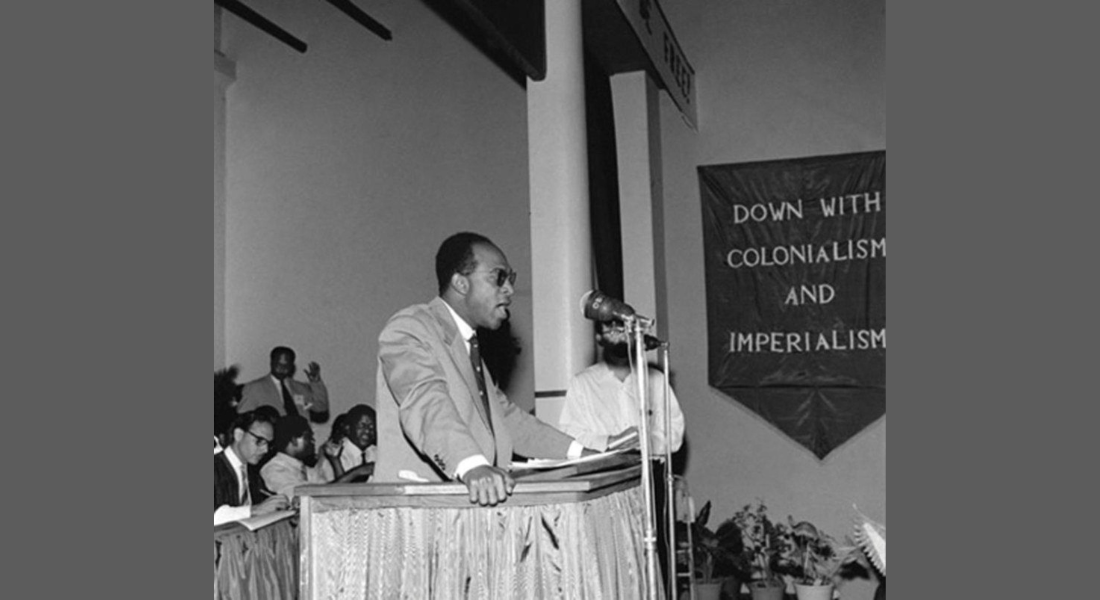 Foto: Frantz Fanon, photographer unkown
Subscribe to our newsletter
Enter your email to subscribe to CULTMIND Kaleidoscope.